Top 10 Milk Processing Equipment Manufacturers Worldwide
The global milk processing industry is changing quickly. Automation, hygienic design, energy efficiency, and digital monitoring now influence every production line. Equipment must protect milk quality from reception to packaging. Small temperature errors can affect taste, safety, shelf life, and product yield.
Professor Harjinder Singh, a respected dairy-processing researcher, has emphasized, “Milk quality begins with the quality of the raw material.” That principle remains practical. A modern separator cannot fully correct poor farm handling or delayed cooling. It sounds obvious. Yet companies sometimes overlook it.
This overview examines ten leading milk processing equipment manufacturers worldwide. The discussion considers processing systems, installation experience, technical support, hygienic construction, and long-term operating value. It also looks at pasteurizers, homogenizers, separators, evaporators, filling machines, and complete dairy lines. Reliable manufacturers provide more than polished brochures. They show documented performance, trained service teams, clear maintenance plans, and equipment that fits real factory conditions.
No ranking is flawless. Purchasing decisions depend on plant capacity, milk composition, labor skills, local utilities, and regional regulations. A small cheese producer may value flexibility more than maximum throughput. A large powder plant may prioritize heat recovery and continuous automation. Buyers should compare verified specifications, not promises alone. Site visits, reference projects, and operator feedback often reveal details that marketing materials hide.
The strongest suppliers combine engineering depth with practical dairy knowledge. Their systems must run cleanly, consistently, and economically. That standard guides this international review of milk processing equipment manufacturers.
Global Milk Processing Equipment Manufacturers: Industry Scope and Criteria
Top 10 Milk Processing Equipment Manufacturers Worldwide
Global Milk Processing Equipment Manufacturers: Industry Scope and Criteria
The global equipment market follows rising dairy demand, stricter hygiene rules, and increased automation. The OECD-FAO Agricultural Outlook 2024-2033 projects steady growth in global milk production during the next decade. FAOSTAT records worldwide milk output above 900 million tonnes annually. That scale requires reliable systems for separation, pasteurization, homogenization, drying, and packaging.
The “top 10” should not mean the largest companies alone. Capacity matters. So do cleaning performance, heat recovery, water consumption, digital monitoring, and service response. Grand View Research reports continued growth in automated food-processing equipment, supported by labor shortages and traceability requirements. A serious comparison should examine verified throughput, stainless-steel quality, validated cleaning cycles, spare-part access, and operating costs. Factory trials reveal more than brochures.
Data can be incomplete. That matters. Some manufacturers publish detailed efficiency figures, while others provide only broad claims. Regional standards also change equipment specifications. A system designed for powdered milk may not suit cultured products without process modifications. Buyers should review installation records, maintenance logs, operator training, and lifecycle energy data. A low purchase price can become expensive when seals, sensors, or pumps fail early. Market rankings remain useful, but they need technical evidence and cautious interpretation.
Top 10 Milk Processing Equipment Manufacturers Worldwide
Global Milk Processing Equipment Manufacturers: Industry Scope and Criteria
Global milk-processing equipment demand is closely linked to the volume and composition of raw milk entering dairy supply chains. Cow and buffalo milk represent the largest processing base, while goat, sheep, and camel milk support specialized equipment requirements for cheese, yogurt, powder, UHT, and other value-added products. Data are rounded estimates for 2022 from FAOSTAT’s Crops and Livestock Products database.
Core Technologies Used in Modern Milk Processing Equipment
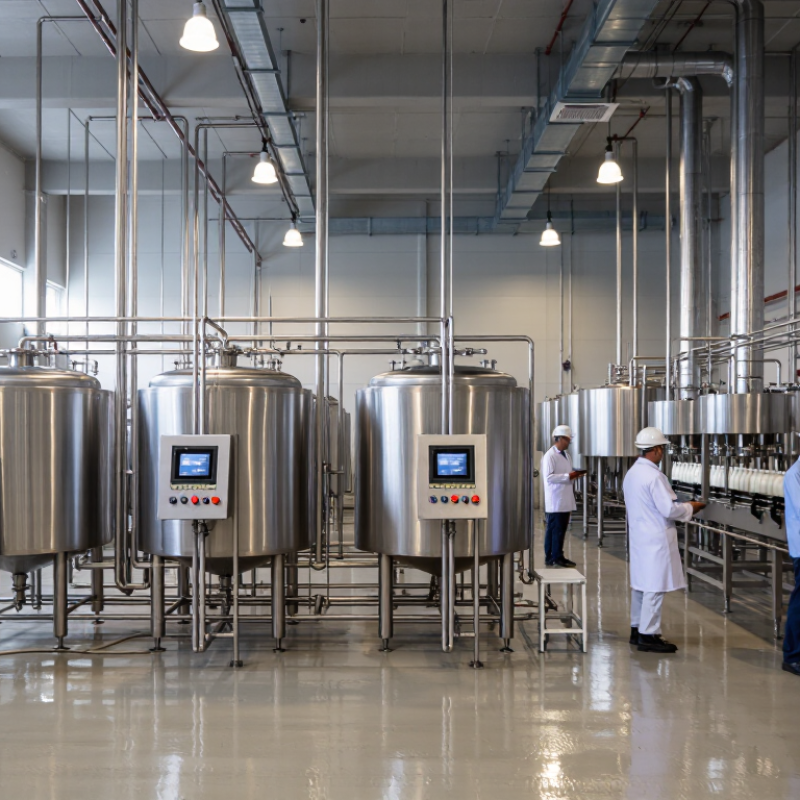
Modern milk processing equipment combines controlled heat, precise flow, and hygienic design. In commercial plants, pasteurization remains the critical safety barrier. High-temperature, short-time systems heat milk rapidly, hold it briefly, then cool it below 4°C. This protects quality while limiting heat exposure. Temperature probes, flow meters, and automatic diversion valves support reliable control. Small calibration errors can create serious quality risks.
Homogenizers force milk through narrow valves at high pressure. This breaks fat globules into smaller particles and improves texture. Membrane filtration can concentrate proteins or reduce unwanted microorganisms without severe heating. It uses pressure across fine membranes. Fouling remains a practical problem. Operators must monitor pressure, flow, and cleaning frequency. Otherwise, energy use rises and product consistency falls. Plant audits often reveal that neglected sensors cause more trouble than major equipment failures.
Clean-in-place systems circulate water, alkaline detergent, acid, and sanitizer through closed pipelines. Correct time, temperature, concentration, and flow create repeatable hygiene performance. Modern controllers record these parameters for traceability and maintenance planning. Aseptic filling adds sterile packaging conditions after ultra-high-temperature treatment. Heat recovery units transfer energy from hot product streams to incoming milk. This lowers utility demand, although poor balancing may reduce savings. In my view, the best equipment is not always the most complicated. It is the system operators can verify, clean, and repair confidently.
Top 10 Milk Processing Equipment Manufacturers Worldwide - Core Technologies Used in Modern Milk Processing Equipment
| Manufacturer Profile | Primary Equipment Scope | Core Technology | Typical Processing Range | Key Operating Parameters | Hygienic Design Features | Automation and Control | Typical Applications |
|---|---|---|---|---|---|---|---|
| Manufacturer Profile 01 | Milk reception, clarification, separation and standardization systems | Centrifugal separation with automatic fat standardization | 5,000–100,000 litres per hour | Milk cooling commonly maintained at 2–6°C before processing; separator operation generally near 45–55°C | Stainless-steel product-contact surfaces, hygienic pipework and clean-in-place compatibility | PLC-based flow, temperature, pressure and fat-content control | Fluid milk, cream, standardized milk and skim milk production |
| Manufacturer Profile 02 | Pasteurizers and high-temperature short-time treatment lines | Regenerative plate heat exchange | 2,000–80,000 litres per hour | Typical HTST treatment: 72–75°C for approximately 15 seconds, subject to local regulations and product requirements | Positive flow diversion, sealed product circuits and automatic hygiene monitoring | Continuous temperature recording, safety interlocks and recipe management | Pasteurized drinking milk, cream and cultured-product bases |
| Manufacturer Profile 03 | UHT processing and aseptic milk treatment equipment | Direct steam injection or indirect tubular heat treatment | 3,000–40,000 litres per hour | Common UHT conditions: approximately 135–150°C for a few seconds, followed by rapid cooling | Sterile barriers, aseptic valves, hygienic tanks and validated sterilization cycles | Aseptic sequence control, electronic batch records and alarm tracking | Long-life milk, flavored milk, cream and liquid dairy beverages |
| Manufacturer Profile 04 | Evaporation systems for milk and whey concentration | Multi-effect falling-film evaporation with thermal or mechanical vapor recompression | Evaporation capacity of approximately 1,000–20,000 kilograms of water per hour | Vacuum operation lowers boiling temperatures and helps reduce thermal damage | CIP-capable evaporator bodies, sanitary condensate separation and drainable piping | Automatic solids-content, vacuum, steam and feed-flow control | Condensed milk, milk powder feed, whey concentrate and dairy ingredients |
| Manufacturer Profile 05 | Spray dryers and powder-handling systems | Two-stage spray drying with integrated fluid-bed finishing | Powder output commonly ranging from 100 to 5,000 kilograms per hour | Inlet air often approximately 160–220°C; outlet temperature is controlled according to product moisture and heat sensitivity | Food-grade air filtration, hygienic chambers and dry-cleaning or wet-cleaning provisions | Moisture, outlet temperature, feed concentration and powder-flow monitoring | Whole milk powder, skim milk powder, whey powder and infant-nutrition ingredients |
| Manufacturer Profile 06 | Membrane filtration and dairy fractionation equipment | Microfiltration, ultrafiltration, nanofiltration and reverse osmosis | 1,000–50,000 litres per hour, depending on membrane area and product | Cross-flow operation limits fouling; pressure and temperature vary by membrane process | Low-hold-up sanitary modules, hygienic seals and automated membrane cleaning cycles | Transmembrane-pressure, permeate-flow and conductivity monitoring | Protein concentration, lactose reduction, whey processing and water recovery |
| Manufacturer Profile 07 | Homogenizers and emulsion-processing systems | High-pressure valve homogenization | 500–30,000 litres per hour | Operating pressure commonly 100–250 bar for milk, depending on formulation and desired particle size | Sanitary pump heads, aseptic options and product-contact parts designed for CIP | Pressure regulation, vibration protection and automatic process-status monitoring | Drinking milk, cream, recombined milk and dairy beverages |
| Manufacturer Profile 08 | Fermentation, culturing and yogurt-processing lines | Controlled incubation with automated pH and temperature management | Batch and continuous systems from 500 to 50,000 litres per batch or cycle | Yogurt fermentation commonly occurs around 40–45°C; endpoint is often determined by pH near 4.5–4.7 | Agitated hygienic tanks, sanitary sampling points and validated CIP programs | Recipe-based dosing, pH trending, temperature control and batch traceability | Set yogurt, stirred yogurt, fermented drinks and cultured cream |
| Manufacturer Profile 09 | Cheese-making vats, curd handling and whey separation equipment | Programmable coagulation, cutting, stirring and curd-whey separation | 1,000–30,000 litres per cheese-making batch | Coagulation temperature commonly ranges from 30–35°C, depending on cheese variety | Rounded hygienic vessels, sanitary agitators and fully drainable product zones | Automated cutting schedules, curd-size control and whey-level monitoring | Cheddar-style, pasta-filata, fresh and semi-hard cheese production |
| Manufacturer Profile 10 | Filling, packaging, CIP and utility-integration systems | Aseptic or hygienic filling combined with automated clean-in-place circuits | Approximately 2,000–40,000 packages per hour, depending on format | CIP stages typically include pre-rinse, caustic wash, intermediate rinse and acid wash when required | Closed product paths, hygienic filling heads, air filtration and automated sanitation verification | SCADA connectivity, production reporting, recipe control and condition monitoring | Carton, bottle, pouch and cup packaging for milk and liquid dairy products |
Note: Capacity figures and operating ranges are representative industry values. Actual specifications vary according to product composition, regulatory requirements, plant layout and equipment configuration.
Top 10 Milk Processing Equipment Manufacturers Worldwide
The worldwide milk processing equipment market is becoming more automated, hygienic, and energy-conscious. FAOSTAT reported global milk production above 950 million tonnes in 2023, creating steady demand for reliable processing lines. Recent analysis from Grand View Research also indicates continued market growth through 2030, supported by urbanization, packaged dairy consumption, and stricter food-safety controls.
The top ten manufacturers are typically judged by engineering capability, installed capacity, after-sales service, and process flexibility. Their equipment commonly includes pasteurizers, separators, homogenizers, evaporators, filling systems, and clean-in-place units.
Experienced processors now examine heat recovery, water use, sensor accuracy, and digital traceability before purchasing. These details affect operating costs every day.
Performance still varies by region. A compact processor may value modular equipment, while a large plant may require continuous high-volume production. The International Dairy Federation emphasizes efficiency, safety, and sustainability across modern dairy operations. However, rankings remain imperfect. Public revenue reports rarely separate milk equipment from other industrial sales. Some suppliers also disclose limited installation data. Buyers should therefore compare verified references, maintenance response times, validation records, and lifecycle costs instead of trusting visibility alone.
How Milk Processing Equipment Manufacturers Compare
Comparing milk processing equipment manufacturers requires more than checking purchase prices. The OECD-FAO Agricultural Outlook 2024-2033 projects global milk production to grow by about 1.6% annually. This expansion increases demand for hygienic, scalable, and energy-efficient processing lines. Strong manufacturers therefore offer reliable pasteurizers, separators, homogenizers, filling systems, and cleaning-in-place controls. Their value appears during daily operation, not only during installation.
Energy performance separates similar suppliers. The International Dairy Federation reports that dairy processing remains sensitive to heat, refrigeration, water, and wastewater costs. Efficient heat recovery can reduce steam demand, while variable-speed pumps can limit unnecessary electricity use. Buyers should compare measured consumption per tonne of milk, not broad efficiency claims. The details matter. Ask for factory test records, sanitation cycle times, spare-parts availability, and verified uptime.
Digital control systems also create differences. Better platforms record temperature deviations, cleaning data, maintenance alerts, and batch histories. That evidence supports traceability and faster troubleshooting. However, automation is not automatically superior. A complicated interface may slow operators during a fault. I have seen specifications look impressive while local service support remained weak. The 2024 Global Dairy Outlook also highlights cost pressure across dairy supply chains, making lifecycle cost more useful than the initial quotation. A fair comparison should include installation, training, water use, energy demand, maintenance, and expected service life. Some figures still depend on site conditions, so published results need independent validation.
Key Factors for Selecting a Milk Processing Equipment Manufacturer
Top 10 Milk Processing Equipment Manufacturers Worldwide
Selecting a milk processing equipment manufacturer requires more than comparing purchase prices. FAOSTAT reported global milk production at roughly 930 million tonnes in 2022. This scale increases pressure on uptime, hygiene, and process control. Your supplier should demonstrate experience with pasteurization, separation, homogenization, filling, and clean-in-place systems.
Ask for measurable evidence. Request factory acceptance test records, validation procedures, energy data, and references from facilities with similar capacity. The equipment should support recognized hygienic design principles and provide traceable temperature records.
Small details matter. Smooth welds, accessible valves, and short drain paths reduce cleaning risks. The 2024 OECD-FAO Agricultural Outlook expects continued dairy demand growth, but forecasts are not guarantees. Local milk quality and utility limits can change the result.
Lifecycle cost deserves equal attention. Compare water use, steam demand, spare-part availability, software support, and technician response times. A lower quotation may conceal expensive downtime. Sometimes, it does.
Manufacturers should also explain how their controls integrate with laboratory testing and production data. Cybersecurity deserves attention, even in older plants. Do not accept vague promises.
One weakness remains common: buyers may overestimate future capacity and purchase oversized lines. A staged design can be more practical, but only when expansion space, piping, and electrical loads are planned early.
Supplier transparency matters more than polished presentations.
Related Posts
-
10 Best Milk Processing Equipment for Global Buyers
-
Top Milk Processing Plant Manufacturers Worldwide
-
Top 10 Milk Processing Companies in China Revolutionizing the Dairy Industry?
-
Top 10 Dairy Farming Practices in China for Global Buyers?
-

Why Is Dairy Farming Essential for Global Food Supply?
-
Top 10 Benefits of Using European Butter for Your Recipes?