Top PVC Shoe Mould Manufacturers for Global Buyers
Choosing the right Pvc Shoe Mould manufacturer can shape product quality, production speed, and long-term business stability. Global buyers need more than attractive quotations. They need suppliers with proven tooling experience, precise engineering, and dependable communication.
A reliable manufacturer should understand EVA, PVC, rubber, and other common footwear materials. Its technical team should review shoe patterns, sole structures, shrinkage rates, and ventilation requirements before production. Well-finished moulds show clean edges, balanced cavities, and consistent dimensions. Small details matter. A rough surface can affect appearance, while poor alignment may create costly defects.
This guide examines leading Pvc Shoe Mould manufacturers serving international buyers. It considers manufacturing capacity, quality control, customization support, production equipment, certifications, and export experience. Factory visits, sample inspections, and trial production can reveal more than marketing claims. Buyers should request clear drawings, material specifications, inspection records, and realistic delivery schedules.
No supplier is perfect. Even experienced factories may face delays, design changes, or communication gaps. That is why careful evaluation remains essential. A strong partnership depends on transparent pricing, responsive after-sales service, and practical problem-solving. These qualities help buyers reduce production risks and maintain consistent footwear quality across different markets.
The manufacturers discussed here are selected for their technical capability, industry reputation, and suitability for global sourcing. Their strengths may differ. Some focus on high-volume orders, while others provide flexible solutions for customized designs or smaller production runs. Understanding these differences can help buyers choose a mould partner that matches their products, budget, and growth plans.
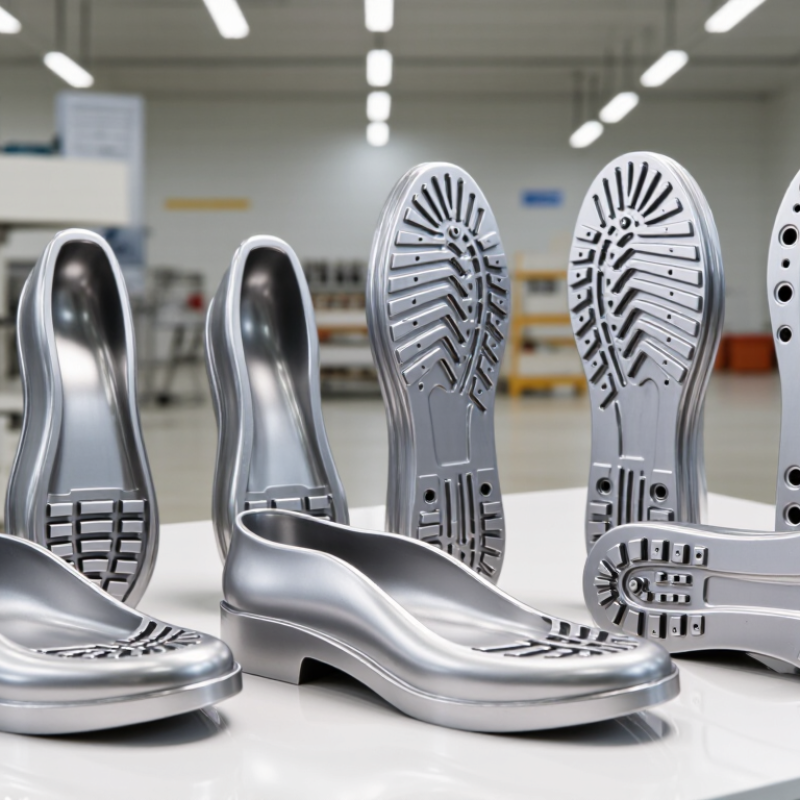
PVC Shoe Moulds: Materials, Types, and ISO 20457 Tolerance Standards
For global buyers, PVC shoe mould selection begins with material behavior, not catalogue appearance. PVC compounds commonly combine resin, plasticizer, stabilizer, pigments, and mineral fillers. Flexible PVC suits uppers and soft soles. Rigid or semi-rigid grades support firmer sole structures. Plasticizers change flow, shrinkage, hardness, and demoulding performance. The PlasticsEurope Plastics—The Facts 2023 report recorded 400.3 million tonnes of global plastics production in 2022. That figure signals scale, not automatic quality.
Mould geometry must match the process. Injection moulds need balanced gates, controlled cooling, and polished vents. Compression moulds demand accurate cavity depth and consistent pressure distribution. Multi-colour and two-density designs add alignment risks. Sole moulds often require deeper tread details and replaceable inserts.
Footwear demand remains huge: the World Footwear Yearbook 2024 reported 23.9 billion pairs produced worldwide in 2023. Yet volume can hide weak sampling. A beautiful first shot proves very little.
ISO 20457:2018 provides tolerance principles for plastic moulded parts, including dimensional, form, and positional control. It uses tolerance classes rather than one universal allowance. Buyers should specify the class, nominal dimensions, material grade, measurement temperature, and inspection method.
Shrinkage, warpage, and cavity wear require practical review. In production, a 0.2 millimetre mismatch can create visible sole flashing or uneven tread contact, depending on the design. That detail matters.
Ask for capability data from repeated samples, not one approved pair. I would also challenge overly tight drawings; they may increase machining cost without improving fit. ISO compliance is a framework, not a substitute for process evidence.

How PVC Shoe Moulds Are Made at 160–200°C Injection Temperatures
Global buyers assessing PVC shoe mould manufacturers should examine process control, not polished photographs. In practical trials, PVC pellets are dried when the formulation requires it, then fed into a heated barrel. The material usually reaches about 160–200°C before injection.
This is the critical window.
Too little heat leaves short fills and visible weld lines. Too much heat can darken PVC, create odor, or damage sensitive additives. Operators should verify melt temperature with calibrated sensors, because machine displays may drift.
The mould is machined from suitable tool steel, polished at the sole cavity, and fitted with vents.
Vents matter. They release trapped air near the toe and heel.
During injection, pressure drives molten PVC through runners and gates into the cavity. A balanced gate layout reduces uneven filling and unwanted flash. Cooling channels then remove heat while the sole keeps its intended shape. Cycle time depends on thickness, design, material grade, and cooling efficiency.
From my process reviews, the first sample is rarely production-ready.
Minor sink marks may appear around thick logos or raised patterns. That is useful evidence, not failure. Engineers adjust holding pressure, cooling time, or gate dimensions step by step.
One detail is easy to overlook: measure shrinkage after conditioning, not immediately after ejection.
Reliable manufacturers record these results across several moulding cycles. Some assumptions still need checking when a new PVC compound behaves differently.
Key Criteria for Ranking Global Manufacturers: ISO 9001, Cavities, and Lead Times
Top PVC Shoe Mould Manufacturers for Global Buyers
Global buyers should rank PVC shoe mould manufacturers against measurable evidence, not attractive catalogs. ISO’s Survey of Certifications 2022 recorded 1,265,216 ISO 9001 certificates worldwide. This figure shows broad adoption, but certification alone does not guarantee accurate moulds. Ask for the current certificate, scope, audit status, and corrective-action records. A reliable factory should explain how it controls steel inspection, CNC machining, polishing, and dimensional approval. Request sample reports with tolerances, not promises.
Cavity count also needs careful evaluation. More cavities can reduce unit costs, but they may increase balancing problems, cooling demands, and maintenance time. For PVC soles, check filling uniformity around heels, edges, and textured surfaces. A manufacturer with fewer cavities may deliver better consistency. Lead time should be separated into design, machining, trial, revisions, and mass production. Industry buyers often quote only mould completion time, which creates avoidable confusion. That practice deserves criticism. Measure the complete timeline, including sample approval and corrective changes.
Tips: Compare three written quotations using identical drawings and material requirements. Ask for cavity layouts, steel grades, trial-shot videos, and inspection records. Confirm whether the quoted lead time includes modifications. A practical benchmark is a weekly progress update with dated photographs. Also check spare-part availability and response time after delivery. These details reveal operational maturity better than a polished showroom. No ranking is perfect. Production history matters most.
Top PVC Shoe Mould Manufacturers for Global Buyers - Key Criteria for Ranking Global Manufacturers: ISO 9001, Cavities, and Lead Times
Anonymous supplier profiles ranked against practical criteria for PVC footwear mould sourcing.
| Rank | Anonymous Profile | ISO 9001 Quality System | Typical PVC Shoe Mould Cavities | Standard Lead Time | Complex Mould Lead Time | Dimensional Inspection | Prototype / Sampling | Export Documentation | Screening Score |
|---|---|---|---|---|---|---|---|---|---|
| 1 | Profile A High-volume export manufacturer | Certified Current certificate required | 2–24 cavities | 15–25 business days | 25–40 business days | 3D measurement report and first-article inspection | Available before production approval | Commercial invoice, packing list, and standard export documents | 92 / 100 |
| 2 | Profile B Multi-style footwear mould supplier | Certified Scope should cover mould production | 1–16 cavities | 18–28 business days | 30–45 business days | Coordinate measuring equipment and steel inspection records | Available for approved technical drawings | Export packing and documentation support | 88 / 100 |
| 3 | Profile C Flexible mid-volume manufacturer | Certified Verify certificate validity | 1–12 cavities | 20–32 business days | 35–50 business days | Manual and digital inspection reports | Available with paid sampling option | Basic export documentation and wooden-case packing | 84 / 100 |
| 4 | Profile D Small-batch and custom-design specialist | Evidence required Request certificate and audit records | 1–8 cavities | 22–35 business days | 40–55 business days | Inspection report available by order | Available for selected designs | Standard export support | 78 / 100 |
| 5 | Profile E Cost-focused general mould producer | Evidence required Confirm quality-system coverage | 1–6 cavities | 25–40 business days | 45–60 business days | Basic dimensional inspection | Subject to capacity and tooling plan | Documentation available on request | 72 / 100 |
Buyer verification note: Lead times are typical business-day ranges for approved designs and may change with mould complexity, material selection, order quantity, drawing revisions, and production capacity. Buyers should verify the current ISO 9001 certificate, cavity layout, inspection records, sample approval process, and written delivery commitment before placing an order.
Leading PVC Shoe Mould Manufacturers by Technology, Capacity, and Export Reach
Top PVC Shoe Mould Manufacturers for Global Buyers
Leading PVC shoe mould manufacturers differ in technology, production capacity, and export reliability. Experienced suppliers use CNC machining, precision EDM, and 3D design software to create accurate mould cavities. These methods support clean textures, stable dimensions, and consistent sole patterns across production batches. A practical factory should also provide trial moulding before shipment. This reveals flashing, uneven cooling, or difficult demoulding problems early. Small errors matter.
Capacity is more than a large workshop. Buyers should review machine numbers, skilled technicians, quality checkpoints, and monthly output. Manufacturers with flexible production lines can handle sandals, slippers, boots, and custom PVC components. Reliable suppliers record steel grades, cavity tolerances, cooling layouts, and maintenance history. Their technical teams should explain these details clearly, not hide behind vague promises. Still, no factory performs perfectly every time. A careful buyer should expect revisions during complex projects.
Tips: Ask for recent mould samples, inspection records, and realistic lead times. Confirm packaging standards, spare-part support, and communication after delivery. Export experience also deserves close attention. Suppliers familiar with international shipping can prepare accurate documents and safer wooden cases. They should understand different port procedures and provide clear production updates. Request references from comparable markets, but verify them independently. A low quote may look attractive, yet weak after-sales support can increase total costs.
Global Buyer Checklist: Testing, Tooling Costs, MOQ, Incoterms, and Warranty Terms
Top PVC Shoe Mould Manufacturers for Global Buyers
A reliable buyer checklist starts with testing, not attractive samples. The World Footwear Yearbook 2024 recorded about 23.9 billion pairs produced globally in 2023, with Asia supplying roughly 87% of output. That scale makes repeatable mould quality essential. Request cavity steel details, dimensional reports, trial-shot videos, and samples from at least three production cycles. Test flexing, abrasion, hardness, shrinkage, and bonding against relevant ISO methods, such as ISO 17707 and ISO 20871. PVC compounds can behave differently after cooling. One sample proves little.
Tooling quotations should separate design, machining, inserts, revisions, trial runs, maintenance, and freight. A low mould price may hide expensive corrections. Ask how many design changes are included. Ask who owns the CAD files and mould. Confirm MOQ by colour, size, cavity, and shipment, because “one MOQ” can be misleading. The World Bank’s Logistics Performance Index 2023 highlights customs and delivery reliability as major supply-chain factors. Therefore, write the Incoterm, named place, insurance responsibility, export documents, and risk-transfer point clearly under Incoterms 2020.
Warranty terms need measurable limits. Specify acceptable flash, weight tolerance, sole dimensions, surface defects, and cracking after agreed tests. Define coverage duration, storage conditions, claim evidence, response time, and replacement responsibility. A twelve-month warranty sounds strong, but it may exclude poor storage or compound changes. That is fair, sometimes. It is also easy to dispute. A signed golden sample, inspection record, and corrective-action process usually protect both sides better than general promises.
Top PVC Shoe Mould Manufacturers for Global Buyers
Global Buyer Checklist: Testing, Tooling Costs, MOQ, Incoterms, and Warranty Terms
Indicative market ranges for PVC footwear mould procurement. Tooling costs are shown in USD, while MOQ and lead time use the right axis. Actual values vary according to mould complexity, cavity count, testing requirements, shipping terms, and supplier agreement. Buyers should confirm Incoterms, inspection standards, and warranty coverage before placing an order.
